The search
for correctness has been a long-standing problem for, first of all, mathematics
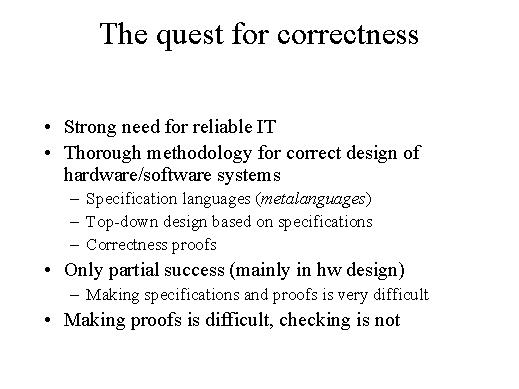
and then computer science. In computer science there is a very strong need
for reliable information technology. And we need correct programmes. We
need programmes that meet their specifications. This can be achieved only
through strong methodologies that should be applied at any level of the
software design cycle. First of all, we need specification languages in
which to specify the behaviour of programmes. Then we want to derive from
these specifications - in a top-down way - the programmes that meet the
specifications. Finally we want to prove that the programme itself meets
its specifications.
We must say that only partial success has been achieved in the last few
years and mainly in hardware design. The fact is that making specification
and proofs is difficult because it requires ingenuity. But it should also
be noted that while making proofs is difficult, checking them is not. So,
we may think to have a system, a computer programmes, that interacts with
the user in order to build a proof but then it checks the correctness of
that proof in a completely automatic way.
| 
|

