It is known
from experience in many areas of investigation that certain averages approach
constant values as the number of observations increase, and what these values
remain the same if the averages are evaluated over a subsequent set of experiments.
The experiments can be evaluated over a subsequent set of experiments. The
experiments can be in such diverse subjects as Sociology, Telecommunications,
Quality Control, System Failure, Statistical Mechanics, Noise and so on.
To take the simplest of experiments if a normal coin is repeatedly tossed,
the fraction of the number of heads, or for that matter tails approaches
0.5. This is true for different sets of experiments with any normal (that
is non defective) coin.
The purpose of probability theory is to describe and predict such averages.
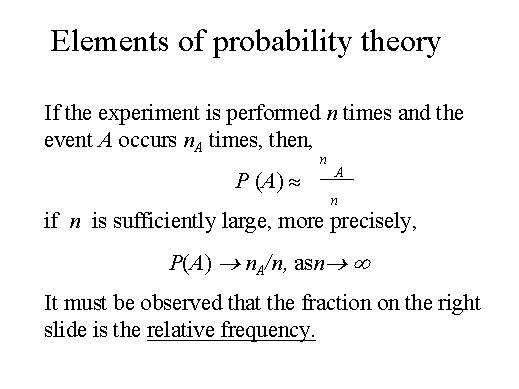
The probability of an event A occurring is the number P(A)
that is assign to this event, and which has the following significance.
| 
|

